

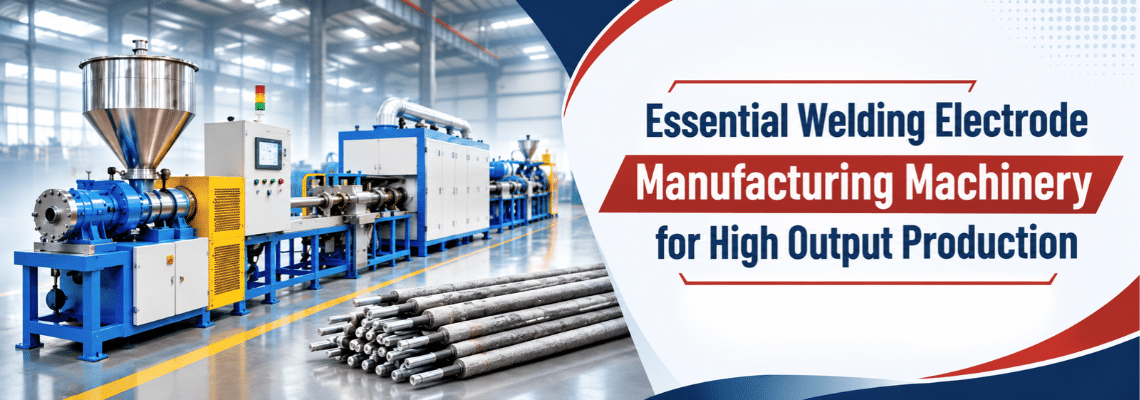
In an electrode plant, the biggest challenge is achieving balanced lines. Many losses occur due to several factors. Some of these factors include a press that outruns the baking oven, a mixer that cannot hold the consistency of the flux, a wire feeder that jams at high speed, or a machine that cannot move the wire at a particular speed, to mention a few.
High output welding electrode production demands several things of the equipment, and in this article, we shall cover those demands and provide a checklist for evaluating equipment.
Key Takeaways
- The speed of the slowest stage determines the overall speed of the line.
- Some factors, such as the consistency of flux and coating concentricity affect rejection rate more than any other thing.
- Curing and drying capacity is the most underestimated constraint.
- Automation, especially with Programmable logic controller
(PLC) and feeding systems, reduces the need for an operator.
- Service and support also play a big role, just like the equipment itself.
- Looking at your target product mix (mild steel vs. low hydrogen vs. stainless) is more important than targeting today’s volumes.
What equipment is required for a welding electrode production line?
An automatic welding electrode production line comprises five main units, including wire preparation, flux preparation, coating, curing and finishing. We will discuss each of these in detail in the next section.
Wire Straightening and Cutting Machine
Wire comes on a spool. This machine straightens it and cuts it to length. The cut isn’t as critical as the straightness. Variety and accuracy of cuts impact how freely rod feeds through the extruder. Burrs are inevitable, but if you have too many burrs or burrs in the wrong place that causes issues downstream. Look for a cutter that will cut stably at the speed you want.
Flux Raw Material Processing Equipment
Before flux mixing, mineral, ferroalloys, and cellulose raw materials must be size reduced to the desired particle size to ensure even arc behavior and adhesion of the coating. Uniform particle size leads to uniform arc behavior and coating adhesion. Size reduction is mainly done by means of pulverizers and vibratory sieves. Omitting proper sieving will cause trouble later in the process and will give inconsistent weld quality.
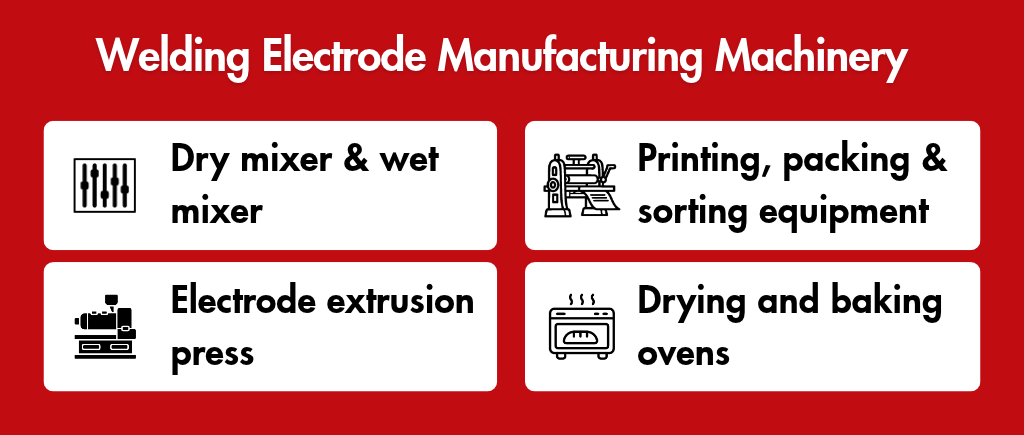
Dry Mixer and Wet Mixer
A dry mixer is used to evenly blend powders. The even blend is then mixed with a liquid binder in a wet mixer. The wet mix is then extruded. A good wet mixer results in a coating with a uniform moisture level and binder ratio, giving the same texture and consistency in batch 50 as in batch 1.
Briquetting Machine
The wet mix is first extruded to the shape of a cylinder and then compression is applied to give the final shape of a briquette. Density of the briquette has a direct correlation to the quality of the coating. Air pockets and voids are a problem that many plant engineers overlook but give rise to coating defects.
Electrode Extrusion Press
This is the heart of the facility. The press is key to the quality and output of the plant and merits the most analysis (more on that below).
Tipping, Brushing, and Gripping End Machines
After extrusion, the gripping end is cleaned to allow contact with the electrode holder, and the tip is prepared for striking the arc. These machines affect the usability and appearance of the finished product and are often considered of lesser importance.
Drying and Baking Ovens
Moisture in the coating of the electrode can result in unwanted weld defects. Low Hydrogen types and general-purpose rods require different baking temperatures. How long and at what temperature the ovens are set determine the type of flux used.
Printing, Packing and Sorting Equipment
At the end of the line, the flux is brand marked, packed and classified. High output of the line makes automated packing and reducing handling of the cartons even more important to prevent damage.
What do you use to assess a Welding Electrode Manufacturing Machine?
Rather than trusting rated speed alone when evaluating welding electrode manufacturing machines across suppliers, use the following.
Is the Extrusion Press Stable?
In Concentricity: Consistent thickness of coating across the length of a rod is critical to stable arc. What press controls to maintain concentricity? Are sample rods available?
Press Stability
Constant pressure helps maintain uniform coating thickness.
Automation Level
How reliant on the skill of the operator is the process? Are controls PLC based? Is process monitoring provided? Does the system automatically feed the wire?
Build Quality, Wear Items and Costs
What material are the press components and nozzles made of? How long do they last? What is the expected service life? What is the cost of replacement components?
Flexibility To Make Different Types and Sizes of Electrodes
Can the machine process the various wire diameters and coatings you need to make mild steel, low hydrogen, and stainless-steel electrodes?
Power, Space, and Utilities
Check the electrical load and compressed air needs early. Make sure to check the floor space requirements and the layout of the plant. A good supplier will assist you with plant layout.
Service and Spare Parts Support
Time is money. The supplier should provide installation support and training and give a time frame for spare parts response.
What Does the Welding Electrode Manufacturing Process Look Like End to End?
To answer that question, we need to take a look at the entire welding electrode manufacturing process:
- Straightening and cutting of the wire.
- Grinding, Crushing and Sieving of Raw Materials.
- Wet and Dry Mixing.
- Briquetting of the Wet Mix.
- Coating of the Wire.
- Preparing the tip and Gripping end.
- Drying and Baking.
- Inspection, Printing and Packing.
Quality checks must take place at every step of the process. The finished product should meet the requirements specified in ASTM A5.1, IS 814 or ISO 2560, standards.
What Mistakes Should Buyers Avoid?
- Buy the press and the rest of the line at the same time.
- Avoid poor flux preparation.
- Choose the lowest machine price and be prepared to pay higher service costs.
- The machine should be tested.
- The machine should be able to keep up with the growth of the plant.
What Possible Upgrades Exist for Welding Electrode Production Equipment?
Not all plants require a complete rebuild. Improvements are best made in specific areas, such as:
- Replace worn dies and nozzles to improve concentricity.
- Improve ovens to reduce bottlenecks.
- Eliminate stoppages with the addition of an automatic feeder.
- Set up data collection and track process to identify reasons for a high rate of rejects.
- When a unit is being modernized or a new unit installed, improving the true bottleneck is more beneficial than spreading a small improvement budget across the entire unit.
What Machinery is Needed to Start a Welding Electrode Production Plant?
To begin production, machinery will be needed to accomplish the following steps: straighten and cut wire; mix flux; briquette; extrude and tip and brush electrodes; dry and bake electrodes; and pack electrodes.
What is the most critical machine for welding electrode quality?
The extrusion presses along with a consistent flux mixing system, determines the uniformity of the coating and, therefore, the performance of the arc.
How can I improve output without purchasing a new line?
The first thing you should look at improving is your oven or feeding system if that is the bottleneck of your process.
Can one line produce different electrode types?
Yes, to a certain extent. Check with your supplier the range of the wires and the coatings and the baking temperature.
Balance Should Be the Focus, Not Just Speed
When aiming for high output production, the focus should be on choosing machinery for the welding electrode manufacturing process that works as a seamlessly integrated system. A good press, a correctly sized oven and consistent reliable mixing and automation systems, can be more beneficial than the fastest machine.
Evaluate the quality and serviceability of each stage and plan. Based on your volume and product mix, plan and then get a second opinion for layout, capacity and equipment. The Logosweld team would be happy to review your production plans and provide input on your machinery alignment.