



Overview
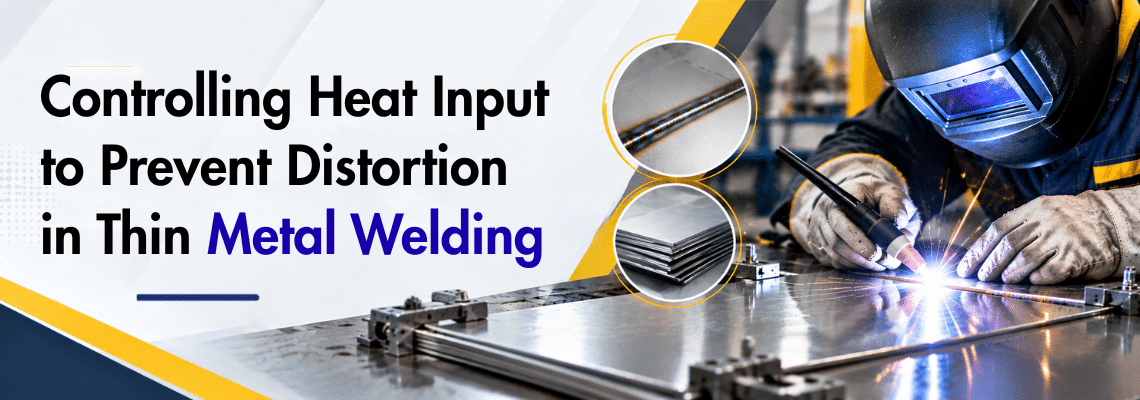
Thin metal welding is highly precise. Thin metal panels under 3mm quickly heat up and keep very little heat. Due to the low heat mass, thin metal panels easily warp from changes in welding current and speed. There is a very fine line between perfectly flat usable metal and metal that needs to be discarded and welded again. This article lays out a few simple tricks to keep welds as flat as possible to overcome the challenges that come with working with thin metal panels.
Preventing Distortion When Welding Thin Metal Sheets
The distortion that occurs during welding of thin sheets is attributed to variations in input of heat. The nature of welding susceptible distortion of thin sheets due to thin sheet having little capacity to store heat. The metal expands as the weld Pool is formed due to Joule heating and contracts during cooling which leads to the formation of stresses. Residual stresses are critical as they cause warpage and bending of the weld. Distortion is thus caused due to variation in input of heat and how the heat is distributed across the welded region.
Optimizing Heat Input for Thin Sheet Welding
Several processes and parameters in welding can help achieve control of distortion. For typical thin sheet processes such as TIG and MIG, control of distortion can be achieved due to the nature of these processes. Short circuit transfer on MIG reduces the heat input. Pulsed MIG has the potential to further reduce average current without adversely affecting fusion. Thin sheets are also susceptible to distortion due to the transfer of welding filler metals. Use of smaller diameter filler metals reduces distortion.
Small diameter wire and faster speed of travel, as energy builds heat, it can dissipate leaving less chance of burn-through or distortion. Travel too slowly or too fast, and the opposite can be true. The best travel speed can take work and can take time to learn, and is probably based on the procedure documented for the specific thickness of material to be welded.
Welding Sequence and Restraint Methods
The application of processing parameters is not the only thing to consider; sequencing is the other major component. Back-step and skip welding techniques distribute heat in a more uniform manner and avoid the build up of heat in one continuous pass. Shrinkage can be counteracted by using tack welds, clamping with chill bars, and performing welds on the opposing sides of the joint.
Sequencing and Restraint Techniques
Sequencing is just as important as process parameters. Back-step and skip welding techniques help to avoid having to wet the entire length of the weld in one pass. Shrinkage forces create tension that tends to pull the work-piece out of position while welds are being added to the joint. This can be addressed by tack welding at intervals, clamping with chill bars, and balancing welds on both sides of the joint.
Conclusion
The welding thin metal sheets, controlling distortion is important, as uneven or excessive heat will cause the final part to have poor shape, dimensions, and overall quality. General metal welding fabrication practices include control of distortion by manipulating the heat input, selecting appropriate welding parameters, application of suitable welding sequence and restraint methods. An established, defined and consistent welding procedure greatly controls distortion and improves consistency of process dimensions to aid quality assurance and final quality checks of the welding process.
torzon market darknet torzon url
torzon darkweb link torzon market
torzon darknet torzon market url
torzon darknet torzon darknet url