


Welding rods:
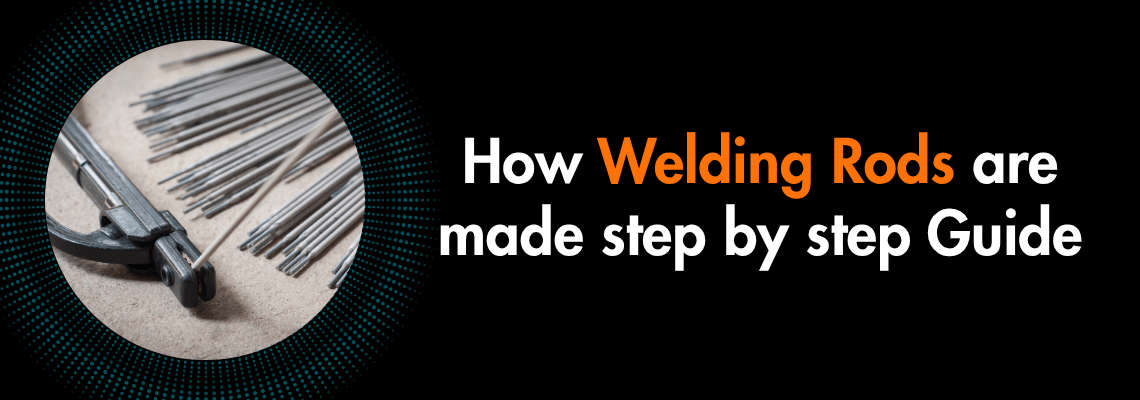
A welding rod, also known as an electrode, is an important component used in industrial fabrication to create strong and reliable welded joints in steel structures. Although it may look like a simple metal rod coated with grey powder, it is actually the result of advanced metallurgical and chemical engineering processes.
Steps to make Welding Rods:
-
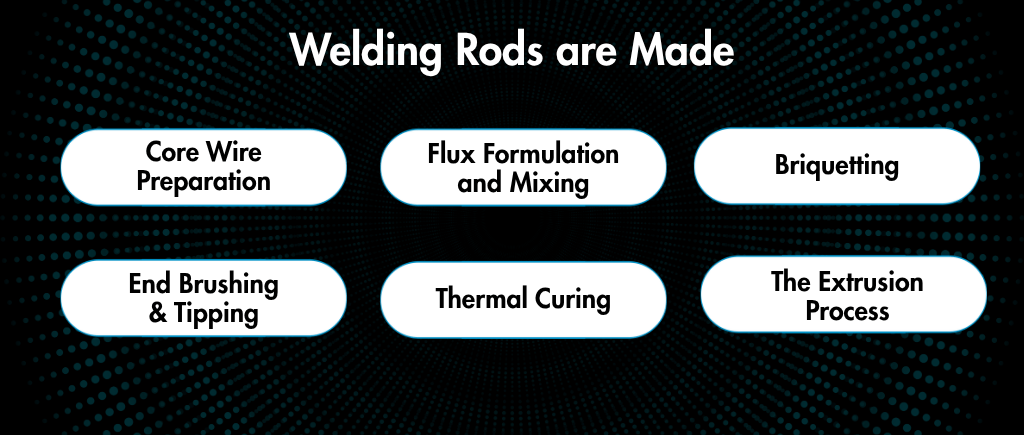
Core wire preparation
The manufacturing process begins with the core wire, which acts as both the electrical conductor and the filler metal during welding.
Drawing:
Raw steel wire coils are pulled through a series of precision dies to reduce the wire to the required diameter with high accuracy.
Cutting and Straightening:
The wire is then straightened and cut into standard lengths using high-speed machines. This process removes the natural coil shape, often called “coil memory.”
-
Flux Formulation and Mixing
The flux coating on a welding rod is made from a carefully balanced mixture of minerals, ferro-alloys, and organic materials.
Dry Mixing:
Materials such as rutile, cellulose, and iron powder are accurately measured within strict tolerance limits. These powders are blended in a dry mixer to achieve a completely uniform chemical composition.
Wet Mixing:
After dry mixing, liquid binders like sodium silicate or potassium silicate, commonly known as water glass, are added to the powder mixture. This creates a thick, dough-like paste suitable for coating.
-
Briquetting
Before the coating process begins, the wet flux paste is shaped into dense cylindrical blocks called briquettes. These briquettes are then loaded into the extrusion press for coating application.
-
The Extrusion Process
This is one of the most critical stages in welding rod manufacturing.
High Pressure Coating:
Core wires are fed into the extrusion press at high speed while the flux briquette is forced through a die-box using powerful hydraulic pressure. This process evenly coats the wire with flux material.
Concentricity Control:
As the wire passes through the die, precision sensors ensure that the wire remains perfectly centred within the coating. If the coating is uneven or off-centre, the welding rod may not perform properly during welding operations.
-
End Brushing & Tipping
Two important finishing modifications are made to improve the usability of the welding rod.
Holder End Preparation:
One end of the rod is cleaned to remove the flux coating, exposing bare steel. This allows the electrode holder to conduct electricity efficiently.
Arc Starting Tip:
The opposite end is tipped or bevelled to help the welder strike and maintain an arc more easily when the rod touches the work surface.
-
Thermal Curing (Baking)
Freshly coated welding rods are still wet and delicate, so they must undergo controlled heat treatment in multiple stages.
Low-Temperature Drying:
The first stage removes surface moisture slowly, preventing damage or cracking in the coating.
High-Temperature Baking:
Depending on the type of electrode, such as low-hydrogen E7018 rods, the electrodes may be baked at temperatures up to 450°C. This process strengthens the chemical bond within the coating and removes moisture completely, helping to prevent welding defects
-
Printing, Inspection and Packing
Identification:
Each welding rod is printed with its AWS classification so welders can easily identify the rod type and specifications.
Quality Audit:
Finished rods undergo quality inspections to check coating strength, coating uniformity, and concentricity.
Sealing:
Finally, the welding rods are vacuum-packed in plastic packaging or metal tins. Proper sealing prevents the flux coating from absorbing moisture during storage and transportation.
Welding rods are made through a carefully controlled manufacturing process that combines metallurgical precision, chemical formulation, and advanced engineering techniques. From core wire preparation and flux mixing to extrusion, baking, and final inspection, every stage plays an important role in ensuring the quality and performance of the finished product. Properly manufactured welding rods provide strong arc stability, reliable weld strength, and consistent performance in industrial applications. This detailed production process ensures that welding rods can meet international quality standards and perform effectively in demanding welding environments