


Have you ever considered why professional welders are comfortable with overhead tasks while novices do flat welding? That is all about mastering the procedure of welding in different positions. As an aspiring welder, someone looking to get certified, or an owner of a fabrication shop, mastering different welding positions will ensure you have stronger joints, can pass inspections, and be safe on the job. This guide will take you through the five positions and provide step-by-step practical strategies that will assist you in achieving your goal.
Importance and Benefits of Mastering Different Welding Positions
Not all welding positions are the same. Some assist while others provide more challenges. For instance, the flat position will assist you, while the overhead will be more challenging. If you can master all of them, you will be more confident and get paid more.
Overview of the Different Types of Welding Positions
-
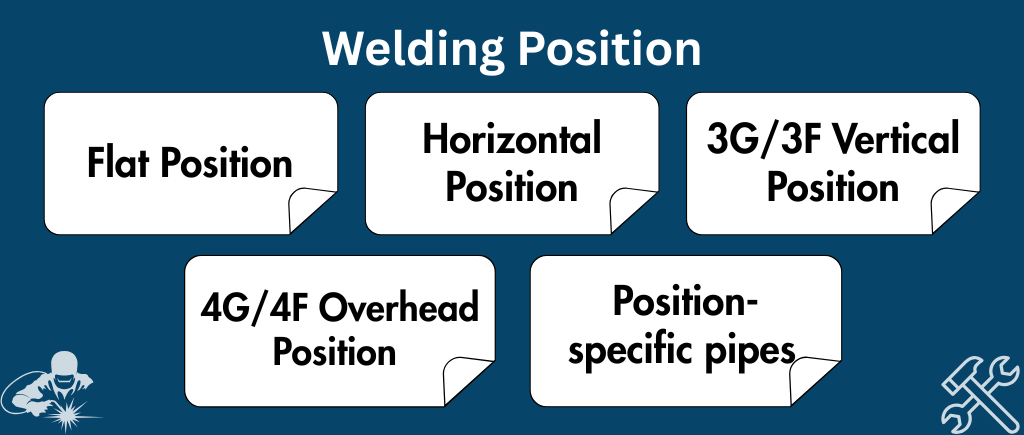
Flat Position (1G/1F)
Start Building Confidence Here First. This is the position where you get to be in full control of the molten metal. You will have the best opportunity to learn how to control the torch and the speed of your movements. This is all about practice and repetition. You will need to be consistent with your movements.
- Best uses: Structural plates, beams, heavy equipment
- Key technique: 0-15° torch angle, steady hand speed
- Certification essential: Every test starts here
-
Horizontal Position (2G/2F)
This will be your first position with any real challenges.You will have to ensure you are nimble and on your toes in order to weave appropriately and control the heat.
- Torch push: 5 – 15° upward angle
- Weave Pattern: Slight Side to Side (3/16″ max width
- Common jobs: Pressure vessels, storage tanks, pipe laterals
-
3G/3F Vertical Position – Uphill Always Wins
Uphill welding gives the deepest penetration, which is ideal for structural work. Downhill is only good for sheet metal.
- Uphill Technique: Stringer beads with a slight circular motion
- Torch angle: 10° in the direction of travel
- Certification Gold: 3G Vertical-Up is structural-ready.
-
4G/4F Overhead Position – Face Your Fear
Sparks fall into your face, which is why gravity is your enemy. Short arcs with high travel speed are essential.
- Position: lean back, helmet down
- Weave: fast travel, minimal if any drips
- Practice: start with smaller beads (1/8″)
-
Position-specific pipes (5G and 6G) – Career Makers
- 5G: Fixed horizontal pipes – no rolling
- 6G: 45° angled pipes – tests all positions in 1
Settings Based On Position
- Flat: Normal everything
- Horizontal: 10% less amps and slower everything
- Vertical up: 15% less amps, and go slow
- Overhead: 20% less amps and fast travel
Your Position = Quality of weld + your back’s condition
- Build a stable position:
- Feet are shoulder distance apart
- Knees are slightly bent
- Your back is straight (yes, even for overhead welds)
- Keep control of your torch:
- MIG: drag technique (15° torch back)
- TIG: push technique (10° torch forwards)
- Overhead:
- Your welding jacket should cover your entire torso
- Position the puddle directly on the line
- Take 2 minutes break every hour
Effective Practice Schedule
- Week 1-2: Flat beads 100x 2 weeks
- Week 3: horizontal fillets 50 x per day
- Week 4: vertical stringers 25x a day going up
- Week 5: overhead plates
- Week 6: 6″ pipe saddles
- Week 7: mock 6G cert test
Correcting Position Mistakes
- Horizontal undercut: too much weaving. Stick to stringers.
- Vertical lack of fusion: Too fast. Count “1-Mississippi” per inch.
- Overhead drips: Weaving too wide. Fast travel speed only.
- Pipe rotation: Don’t roll the 5G practice pipe!
Safety Rules Never Break
- Full leather welding jacket (overhead essential)
- Leather gauntlet gloves (not MIG stingy gloves)
- Auto-darkening helmet (position changes fast)
- Proper body position prevents strains
- Clear underside work area (overhead debris falls)
Stronger Joints, Higher Pay, Better Safety
Perfect welding position technique transforms average welders into structural specialists. Every mastered position means bigger jobs, passing certifications, and premium pay rates.
Build production capacity with precision equipment from Welding Electrode making machine Manufacturers and check out the complete Welding Electrode Plan.