


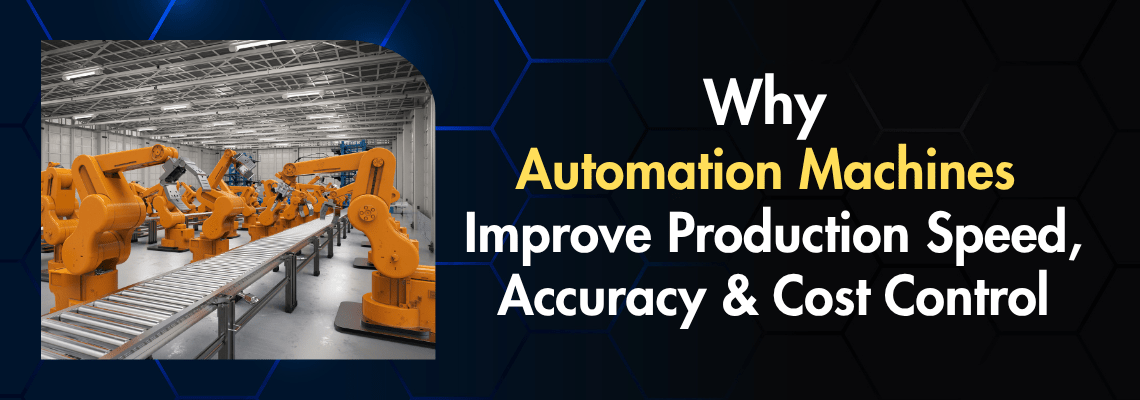
Production speed is the speed at which a plant performs work without excessive idle time. Accuracy Each output must be of the proper size, quality and performance. Cost control is the practice of keeping costs such as labour, material, energy and rework at acceptable levels.
Production Speed, Accuracy, and Cost Control these three elements determine whether a facility remains competitive or falls behind. That’s why an increasing number of organizations are turning to automation to build more efficient, reliable and speedier production systems.
Why Automation Matters
Automation is a way to reduce manual effort and increase process consistency in manufacturing. Machines doing repeated jobs are frequently more consistent in their results than people doing the same tasks.
It also facilitates planning as it is easier to measure and control production. That means fewer disruptions, less waste and better output throughout the plant.”
How Automation Accelerates
Automation means less delays between processes and faster production. They can operate all day, move things efficiently and do repetitive operations considerably faster than physical workers.
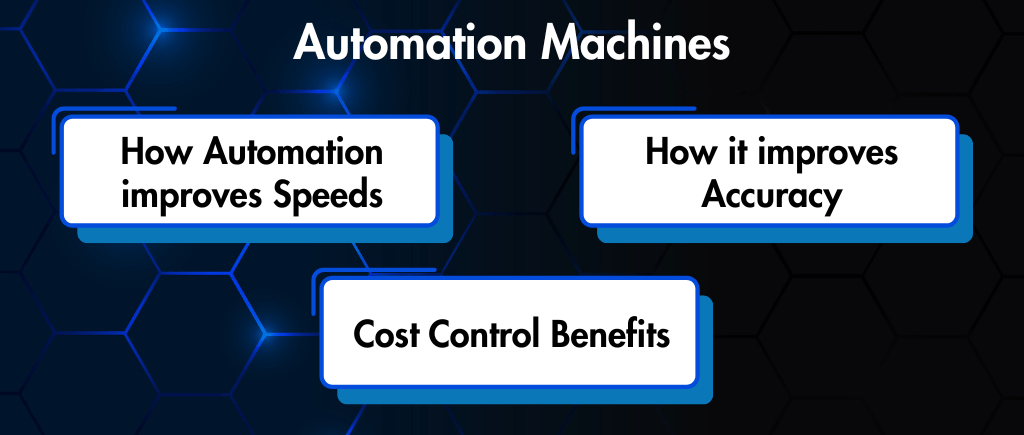
How Automation improves Speeds
Automation speeds up production by reducing the time lags between processes. Machines can work non-stop, transport things around effectively and finish repetitive jobs far quicker than manual workers.
This gives a various benefit:
- More output each shift.
- Reduced production cycles.
- Shorter waiting times between stages.
- Improved workflow continuity.
The increased speeds mean manufacturers can produce more products in less time, helping them to fulfill market demand and improve delivery timetables.
How it improves Accuracy
One of the major advantages of automated systems is accuracy. Machines do what they are programmed to do. Less chance of a person making a mistake and more chance of each unit being the same as the next.
This is significant as slight errors in industrial production might result in rework, rejected batches or consumer complaints.
Automation Supports accuracy by:
- Reproducible readings.
- Reduce variance in repetitive jobs.
- Better alignment and placement.
- Helping to improve quality control.
When procedures are accurate, the end product is better and the plant spends less time fixing preventable faults.
Cost Control Benefits
Cost control is not only about saving money on labour. It also entails eliminating waste, reducing downtime, improving energy usage, and preventing defective output.
Automation aids in all these areas by making processes more predictable and efficient.
Its control cost through,
- Decreased manual dependence.
- Reduction in material wastage.
- Less production errors.
- Less rework required.
- More efficient utilization of resources available.
As a result, the plant pays less to produce more, leading to a better return on investment over time
Choosing a Automation Machines in Business
Businesses love automation because it enables them to grow without adding needless complexity. Good system design makes it easier to manage production and to scale it.
Some of the primary reasons are:
- Improved output stability.
- Lower dependence on labor intensive work.
- Higher product quality.
- Better control on operating costs.
- Improved plant performance.
These benefits can make a huge difference in long-term success in competitive marketplaces.
Logosweld is dedicated to providing reliable equipment and practical industrial solutions that enable firms to establish efficient and consistent processes. That balance is especially critical to organizations that aspire to create long-term value, not just short-term productivity.
Automation is no longer an upgrade; it is a practical way to increase production performance and stay competitive. It boosts speed, improves accuracy, and helps businesses keep manufacturing costs in check more easily. Automation machines are essential to smarter operations and higher efficiency for manufacturers and Logosweld makes that aim a reality with reliable industrial solutions.