


Industrial production is a very dangerous field, so the difference between a “good” weld and a “precise” weld is no longer just how it looks; it’s measured in mils and dollars. As we deal with the needs of modern industry, there isn’t much room for mistake. “Good enough” is a weakness in many fields, such as aircraft and semiconductor manufacturing.
It used to be that Precision welding was a luxury, but now it’s a must if you want to compete in the global market. At this level, getting great results involves combining top-level knowledge with the right technology in a strategic way.
Why is precision welding so important to modern business?
Most of modern industry is based on precision welding, which makes it possible to make strong, complicated, and reliable structures that can’t be made in the same way with traditional methods. With new techniques like laser beam and electron beam welding, businesses may be able to be very exact. Some parts are less likely to get distorted this way, and the weld and structure are also made stronger.
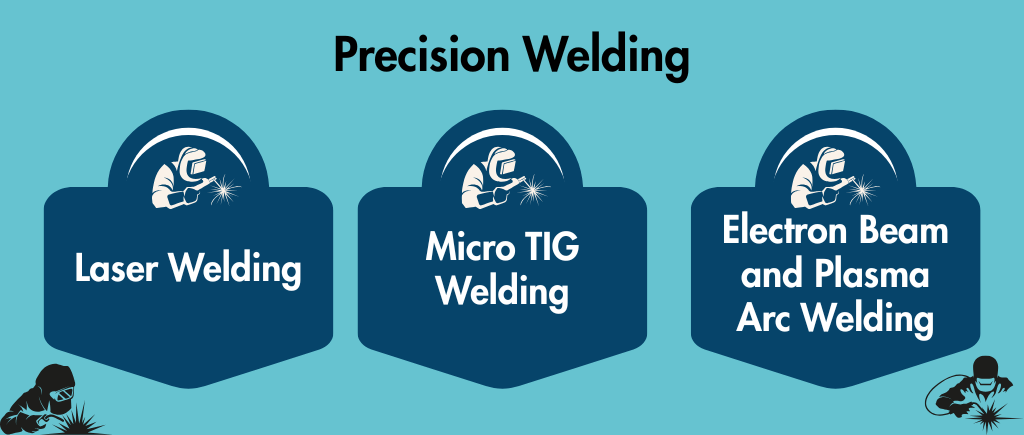
Top Precision Welding Techniques for Superior Results
- Laser Welding:
- Laser beam welding is a fast, high-precision way to combine metals and thermoplastics with a focused light beam and very little heat, which keeps the materials from warping. It makes clean, high-quality welds that don’t need much clean up. It’s great for both automated industrial production and detailed work in small shops.
- Gas of the materials, which then stick together and harden again. You can do it with or without filler wire. Compared to traditional Metal Inert Gas (MIG) or Tungsten Inert Gas (TIG) welding, it’s faster, more accurate, and has less thermal distortion and a smaller heat-affected zone (HAZ).
- Micro TIG Welding
- Micro TIG welding is a high-precision, low-energy method of joining small, fragile parts together using a tungsten blade that doesn’t need to be replaced. The process makes high-quality joins with little heat damage. At 1–50+ Amps, it can weld thin metals, different materials, and fix tools, making it perfect for fields like medicine, cars, and jewellery.
- Pulsed current is used to give the welder full control, reducing gaps and ensuring accurate, clean welds on delicate parts. As a “cold welding” method, it doesn’t damage the part much, which makes it perfect for fixing Molds or delicate parts.
- Electron Beam and Plasma Arc Welding
Plasma Arc Welding (PAW) and electron beam welding (EBW) are both very exact and high-energy ways to join metals. A narrow stream of fast electrons is used to melt metals in an EBW machine. Plasma, an ionized gas, is pushed through a nozzle in a PAW machine to create a strong electric spark.
- Electron Beam Welding (EBW)
EBW employs the kinetic energy of electrons that are moving very quickly to create a lot of heat when they hit a workpiece. A tungsten or tantalum filament (cathode) is heated in a vacuum to make electrons come out. High voltage speeds up these electrons, and electromagnetic lenses focus them into a very intense beam. When the object hits, the kinetic energy turns into very hot thermal energy that rapidly vaporizes and melts the metal.
- Plasma ArcWelding (PAW)
Gas Tungsten spark Welding (GTAW) has been improved upon by Plasma Arc Welding(PAW), which squeezes an electric spark to make a strong plasma jet.
An electric arc is made between a tungsten electrode that doesn’t need to be replaced and the item. Plasma gas, a gas that doesn’t do anything, moves around the electrode, gets charged by the electric arc, and goes through a small copper nozzle that is cooled by water. This tightening makes the plasma into a jet that moves quickly and is very directed.
Words of promise about dependability and success. We now know that the right method is what separates a normal part from a great manufacturing result. It doesn’t matter if you use Electron Beam, Plasma Arc, Laser Beam Welding, Micro TIG, or Electron Beam and Plasma Arc when it comes to high-energy depth.
High-stakes industries like aerospace and semiconductors have strict rules about every joint. These advanced methods make sure that every joint meets those rules by getting rid of structural distortion and shrinking heat-affected zones. Getting better at making things with welding techniques in modern businesses. People who are good at these tiny things will be the ones who set the standards for the next generation of excellence as the business change.