


Welding rods, also referred to as electrodes, are crucial items used in metal fabrication and construction.
For anyone planning to start in this field, it’s important to understand how these rods are manufactured before making investments in equipment or establishing a plant.This blog outlines the main steps involved in producing welding rods, providing new business owners with a realistic view of what is required to set up a production facility.
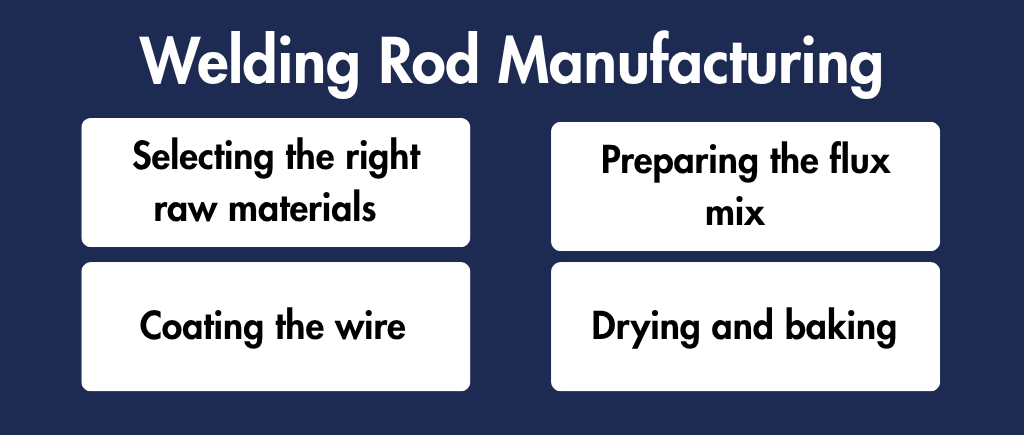
Selecting the Right Raw Materials
Each batch of welding rods starts with a steel wire core and a flux coating made from minerals, ferro alloys, and binding agents.
The quality of these materials directly affects the strength, stability of the arc, and the finish of the final electrode.As a result, manufacturers routinely test each incoming batch.Sourcing consistent, tested raw materials is one of the first key decisions a plant owner must make, as even slight variations can impact the welding performance later.
Wire Straightening and Cutting
The steel wire is initially supplied in coils and must be straightened before it can be coated.
This is done using a wire straightening and cutting machine, which feeds the wire through rollers to eliminate bends and then cuts it to the required length for standard electrode sizes.This process ensures that each rod is uniform in length and has a smooth, flat surface for the coating to be applied.
Preparing the Flux Mix
The flux components are measured and mixed in a dry mixer or a double cone blender until the powder becomes homogenous.
A wet mixer then adds a binding liquid, typically sodium or potassium silicate, to create a paste.Achieving the correct mix ratio is essential, as an uneven mixture can lead to issues such as poor arc control or cracks in the coating.
Coating the Wire
The prepared flux paste is then sent to an extruder, which can be either horizontal or vertical depending on the plant’s layout.
In this stage, the wire core passes through a die that evenly applies the flux coating around it.This step is often regarded as the most critical part of the process, as the accuracy of pressure and alignment determines how consistent and effective each rod will be.
Drying and Baking
After the coating is applied, the rods still contain surface moisture, which needs to be removed.
They are then placed in a baking oven that uses controlled low and high temperatures for a specific period.This drying process hardens the coating and eliminates excess moisture, preventing issues like cracking, spatter, or hydrogen-related defects during welding.
Printing, Inspection, and Packing
Once the rods are dried, they are marked with an online printing unit to indicate their grade.
Skilled workers then inspect the rods using tools such as microscopes and profile projectors to check the coating’s thickness and surface quality.Approved rods are counted, grouped, and packaged using a shrink wrapping machine, making them ready to be shipped to customers.
Choosing Machinery for Efficient Production
Each step in the process relies on specialized machinery designed for precision and consistency.
A poorly functioning mixer, an unreliable extruder, or an inconsistent oven can lower product quality even when the raw materials are of good quality.For this reason, plant owners are advised to work with experienced machinery suppliers who understand both the mechanical and metallurgical aspects of manufacturing, rather than treating equipment purchases as a one-time decision.
Setting Up Your Own Facility
For entrepreneurs considering entering this business, the good news is that while the process can be technical, it follows a clear and learnable sequence once the correct guidance and equipment are in place.
Understanding each phase in advance helps in planning the layout of the factory, staffing, and budget more effectively, and avoids costly problems during the initial setup.
Conclusion
Creating a dependable welding rod manufacturing setup depends on combining high-quality raw materials with accurate, well-maintained machinery throughout the entire production process, from wire preparation to final packaging.
This ensures that each electrode produced performs reliably in real-world welding applications.