


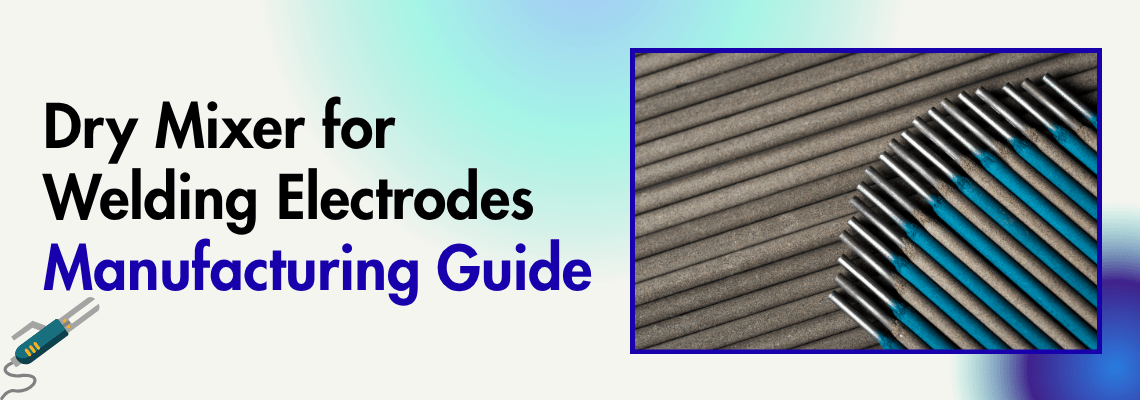
Manufacturing a welding electrode is a sophisticated multi-stage operation that bridges metallurgy and chemical engineering. The process involves transforming raw steel wire into a high-utility tool through several critical milestones:
- Wire Preparation: Raw steel rods are drawn through precision dies to reach exact diameters, ensuring the core provides the necessary electrical conductivity.
- Flux Formulation: This is the most sensitive stage. A precise blend of minerals, alloying agents, and binders is created to form the flux coating that protects the arc, stabilizes the weld, and adds mechanical strength.
- Precision Extrusion: Using high-pressure machinery, the flux is coated onto the core wire. Achieving perfect concentricity (centring the wire exactly within the coating) is vital to prevent “side-arcing” during industrial use.
- Thermal Curing: The final electrodes are baked in multi-stage ovens to remove moisture, a critical step to prevent hydrogen-induced cracking in the final weld.
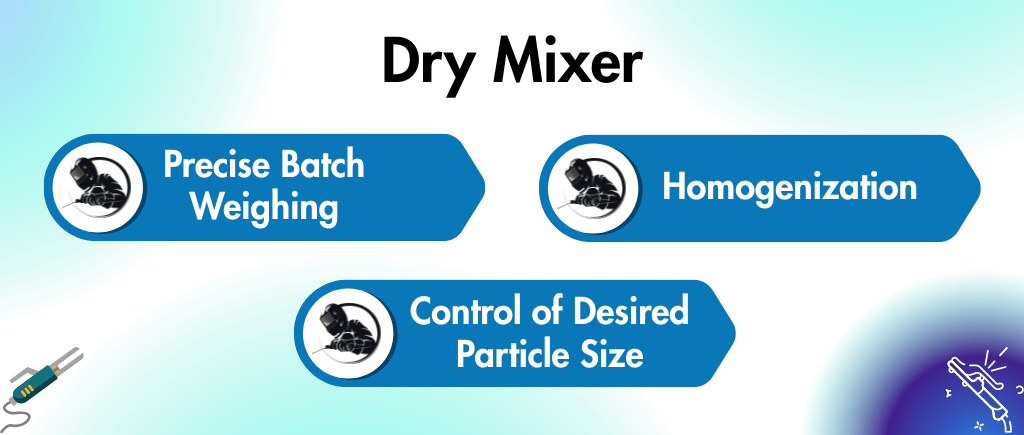
Dry Mixer Functions in the manufacture Flow
In the Flux Preparation stage of production, the dry mixer has the following functions:
-
Precise Batch Weighing.
Theweighing of several types of raw materials, such as rutile, cellulose, iron powder, manganese, and silicates, takes place before entering the dry mixer. In precision weighing, there is tolerance of only a 1% deviation. Because welding mainly involves stability of the arc and the weld’s/mechanical structure, such small deviations can have serious consequences.
-
Homogenization
When powders enter the dry mixer (which is usually a paddle or ribbon mixer), the mixer uses shear and centrifugal forces to distribute the particles.Dry Mixing ensures that every single unit of the entire mixture is exposed to an equal and controlled ratio of each powder component, which also reduces the likelihood of “hot spot” formation.
-
Control of Desired Particle Size Distribution
The best dry mixers are those that are able to prevent segregation of the powders. Iron powder and cellulose powder, for example, will have segregation due to differences in density.
In modern welding electrode manufacturing, the dry mixer plays a key role in ensuring product quality and consistency. It is not just a mixing machine, but an important stage where raw materials are blended accurately to create a reliable flux coating. Proper mixing helps prevent material segregation, reduces batch inconsistencies, and supports better welding performance.
A high-quality dry mixer also helps manufacturers improve production efficiency, reduce material waste, and maintain industry standards. Since the quality of the electrode coating directly affects weld strength and arc stability, effective mixing becomes essential for achieving dependable industrial results.
To understand the complete production process in detail, you can also explore a Welding Electrodes Manufacturing Guide, which explains how different manufacturing stages work together to produce high-performance welding electrodes