


Manufacturing plants that produce welding electrodes are under constant pressure to deliver rods with consistent arc performance, coating strength, and dimensional accuracy. Quality and production managers know that achieving this consistency depends less on chance and more on precise, repeatable machinery at every stage of production. This article looks at the key equipment and controls that shape reliable electrode output on a production floor.
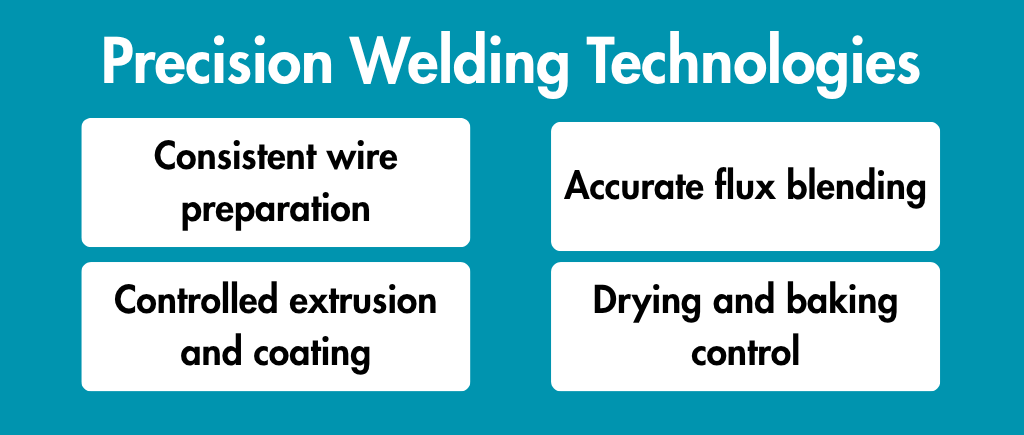
Consistent Wire Preparation
Every electrode starts with a straight, accurately cut steel wire core. A wire straightening and cutting machine removes bends from coiled wire and trims it into uniform lengths, forming the base for a stable coating layer later. Even minor inconsistencies at this stage can cause coating thickness to vary, so tight tolerances here matter more than many manufacturers initially expect.
Accurate Flux Blending
Flux composition directly determines how an electrode performs during welding, including arc stability and slag removal. A dry mixer blends powdered minerals and ferro alloys uniformly, while a wet mixer combines this powder with a silicate binder to form paste. Controlled mixing time and ratio checks at this stage help production teams avoid batch-to-batch variation, which is often the root cause of customer complaints about arc quality.
Controlled Extrusion and Coating
The extrusion stage, using horizontal or vertical extruders, applies the flux coating around the wire core under carefully regulated pressure. Uniform coating thickness along the entire rod length is critical, since uneven coating leads to inconsistent burn rates and poor bead appearance. Regular die maintenance and pressure calibration checks are standard practices in facilities focused on output consistency.
Drying and Baking Control
Coated rods pass through a baking oven with separate low and high temperature zones to remove moisture gradually. Rushing this stage or running ovens at incorrect temperatures can trap moisture inside the coating, which later causes porosity or hydrogen cracking in welded joints. Production managers typically track oven temperature logs closely, since this step has a direct link to field performance complaints.
Inspection Before Dispatch
Before packing, sample rods are checked using microscopes and profile projectors to verify coating thickness, concentricity, and surface finish. This inspection stage acts as a final checkpoint, catching defects that earlier process controls might have missed. Rods that pass are then printed with grade details and packed using automated shrink wrapping equipment for dispatch.
Significance of Equipment Accuracy
For quality managers, the biggest gains in product consistency usually come from equipment precision rather than raw material changes alone. A slightly worn extruder die or a poorly calibrated mixer can silently reduce yield and increase rejection rates over time, even when everything else in the process looks normal on paper. Routine calibration schedules and preventive maintenance plans are therefore treated as core parts of quality management, not optional extras.
Supporting Long-Term Production Goals
Manufacturers aiming to scale output while holding quality steady need machinery that performs the same way on the thousandth cycle as it did on the first. This is why plant teams increasingly favor suppliers who understand both mechanical engineering and metallurgical requirements together, rather than treating machines as generic industrial equipment.
conclusion
Dependable electrode output depends on tightly controlled processes at every stage, and adopting precision welding technologies across mixing, extrusion, baking, and inspection is what ultimately protects product consistency and customer trust over the long run.